
News On Time
Breaking
🔴 Chief Minister Shri Vishnu Deo Sai calls for active youth participation in building a developed Chhattisgarh 🔴 Union Cooperation Secretary lauds Bastar’s ‘Cafe Pandum’ as a model of rehabilitation and self-reliance 🔴 From Fear to Hope: Delhi Influencers Witness Bastar’s Transformation 🔴 Drug-Free and Healthy Chhattisgarh Will Lay the Foundation for a Developed Chhattisgarh: Chief Minister Shri Vishnu Deo Sai 🔴 Providing Employment Opportunities to Youth, Accessible Services to Citizens and Equipping Youth with Modern Skills Our Priority: Chief Minister Shri Vishnu Deo Sai 🔴 Chhattisgarh aims to build a complete mineral value chain within the state, covering exploration, mining, processing, value addition, advanced manufacturing and recycling: Chief Minister Shri Vishnu Deo Sai 🔴 TIN Portal a ‘Mineral-to-Livelihood’ Initiative Linking Mineral Resources with Tribal Livelihoods: Chief Minister Shri Vishnu Deo Sai 🔴 Chief Minister Shri Vishnu Deo Sai Launches ‘E-Ret Sangwari’ Portal 🔴 ‘Mann Ki Baat’ gives national recognition to grassroots innovations, inspiring efforts: Chief Minister Shri Vishnu Deo Sai 🔴 No Compromise on Integrity of Examinations; Strict Action Against Irregularities: Chief Minister Shri Vishnu Deo Sai 🔴 Chief Minister Shri Vishnu Deo Sai calls for active youth participation in building a developed Chhattisgarh 🔴 Union Cooperation Secretary lauds Bastar’s ‘Cafe Pandum’ as a model of rehabilitation and self-reliance 🔴 From Fear to Hope: Delhi Influencers Witness Bastar’s Transformation 🔴 Drug-Free and Healthy Chhattisgarh Will Lay the Foundation for a Developed Chhattisgarh: Chief Minister Shri Vishnu Deo Sai 🔴 Providing Employment Opportunities to Youth, Accessible Services to Citizens and Equipping Youth with Modern Skills Our Priority: Chief Minister Shri Vishnu Deo Sai 🔴 Chhattisgarh aims to build a complete mineral value chain within the state, covering exploration, mining, processing, value addition, advanced manufacturing and recycling: Chief Minister Shri Vishnu Deo Sai 🔴 TIN Portal a ‘Mineral-to-Livelihood’ Initiative Linking Mineral Resources with Tribal Livelihoods: Chief Minister Shri Vishnu Deo Sai 🔴 Chief Minister Shri Vishnu Deo Sai Launches ‘E-Ret Sangwari’ Portal 🔴 ‘Mann Ki Baat’ gives national recognition to grassroots innovations, inspiring efforts: Chief Minister Shri Vishnu Deo Sai 🔴 No Compromise on Integrity of Examinations; Strict Action Against Irregularities: Chief Minister Shri Vishnu Deo Sai
Search News

अपनी पसंद की खबर खोजें

Politics National World State Business Education Health Sports Entertainment Crime Technology Social Media
होम World India donated one million dollars to promote Hindi in the United Na...
India donated one million dollars to promote Hindi in the United Nations
World

India donated one million dollars to promote Hindi in the United Nations

News On Time Desk 19 July 2023
Share :

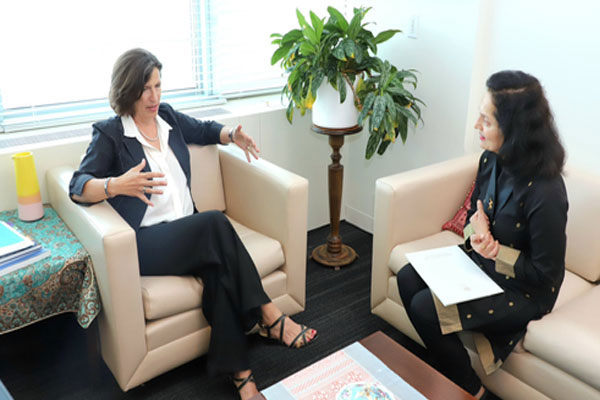
The United Nations has donated one million dollars to the United Nations for the promotion of Hindi. Recognizing India's contribution, Melissa Fleming, Under-Secretary-General for Global Communications, tweeted on Monday, "Grateful for bringing UN news and stories to Hindi-speaking audiences in India." India's Permanent Representative Ruchira Kamboj, who handed over the check to him last Friday, said in a statement that New Delhi would continue to promote the use of the Hindi language at the UN.

He said, the UN's efforts to mainstream and integrate news and multimedia content in the Hindi language have been appreciated in India and in countries where Hindi-speaking populations live. Prime Minister Narendra Modi has addressed the General Assembly and the Security Council, where simultaneous translation is available, but he spoke in English at the International Yoga Day celebrations held at the UN complex last month. Hindi was introduced to the United Nations by former Prime Minister Atal Bihari Vajpayee, who became the first Indian official to speak the language at the United Nations in 1977 when he was the Minister of External Affairs.

The United Nations began in 1945 with the three widely spoken languages ​​of English. French and Spanish took over from their defunct predecessors, the League of Nations, as official and working languages ​​of the two permanent members, along with Russian and Chinese. It added Arabic as an official language in 1973. The United Nations provides simultaneous interpretation and translation of documents in six languages ​​at its meetings. Countries can arrange for simultaneous translation of speeches from their own language as India has done in Hindi or in their own language. UN media organizations began running websites and social media posts in Hindi in 2018, in addition to Swahili and Portuguese.

The United Nations began in 1945 with the three widely spoken languages ​​of English. French and Spanish took over from their defunct predecessors, the League of Nations, as official and working languages ​​of the two permanent members, along with Russian and Chinese. It added Arabic as an official language in 1973. The United Nations provides simultaneous interpretation and translation of documents in six languages ​​at its meetings. Countries can arrange for simultaneous translation of speeches from their own language as India has done in Hindi or in their own language. UN media organizations began running websites and social media posts in Hindi in 2018, in addition to Swahili and Portuguese.

India began its efforts to include Hindi in the list of official languages ​​of the United Nations in 2003 with the formation of a high-level committee headed by the External Affairs Minister, and renewed its efforts in 2007 on the recommendation of the 8th World Hindi Conference. Besides getting approval from a majority of 193 members to include Hindi as an official language, India will have to bear most of the cost of interpretations and translations for the cash-strapped UN.

Last year, India co-sponsored a resolution that mentioned Hindi in the UN General Assembly to ensure that multilingualism is a core value of the UN. The resolution expressed appreciation for the dissemination of information by the United Nations in "non-official languages ​​such as Portuguese, Hindi, Kiswahili, Farsi, Bangla and Urdu" in addition to official languages.